
to connect what cannot be connected
collage mind newsletter / vol. 46 / October 2025

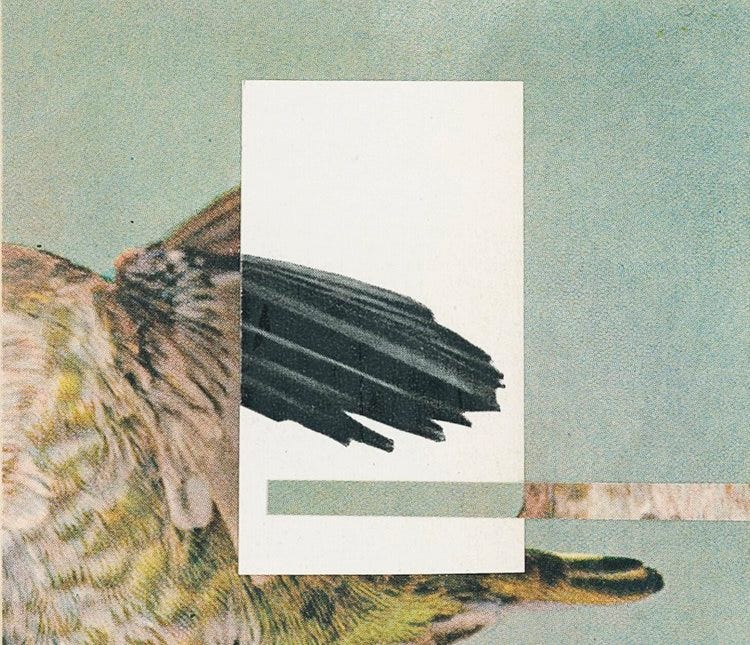
Dear Friends:
October has been a month of archiving for me—putting my own work in order, but also diving into archives at libraries, attending talks about book collections, reading about archiving as an art form, thinking about archiving as a form of collage, and vice versa. I’ve noticed over the years of writing this newsletter that I have archive seasons, and autumn is one of them.
A 2004 essay “An Archive Impulse” by the art critic Hal Foster has been on my mind. I can’t remember how or why it found a way to my reading pile, but I’m glad it did. Foster’s essay provides some excellent descriptions of collage art without meaning to. Like when he reflects on how the artist Tacita Dean begins her work by happening on a photograph or some other artifact, and how from there, through ongoing research, uncovers what Foster calls “a tenuous tissue of coincidences” that guides the project.
A tenuous tissue of coincidences. I don’t think Foster means to be dismissive in that description, though it could be read that way. I suspect he is acknowledging the ghostliness of the work Dean does. The fragile network of intuitive and subtle associations she builds across images and texts, everything meaningful, however slight.
This tissue of coincidences sounds like collage to me. As does a later portion of the essay when Foster speaks of art made from archives, like Dean’s, as driven by the will “to connect what cannot be connected.”
To connect what cannot be connected. Yes.
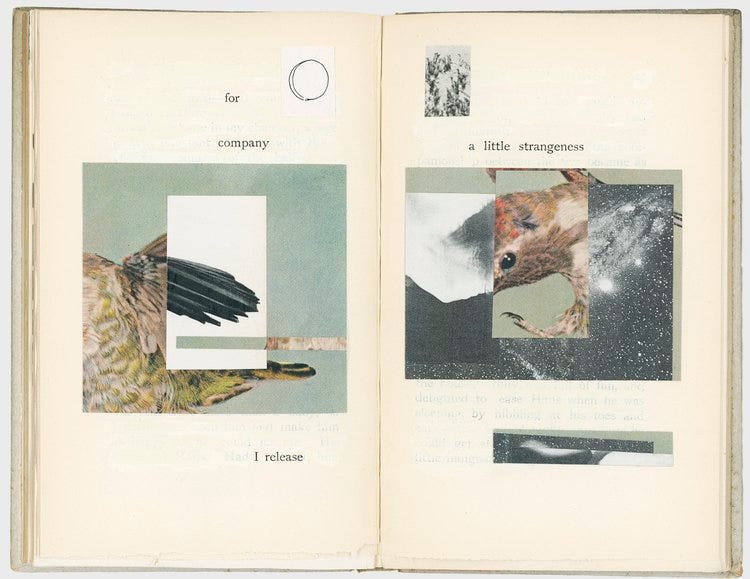
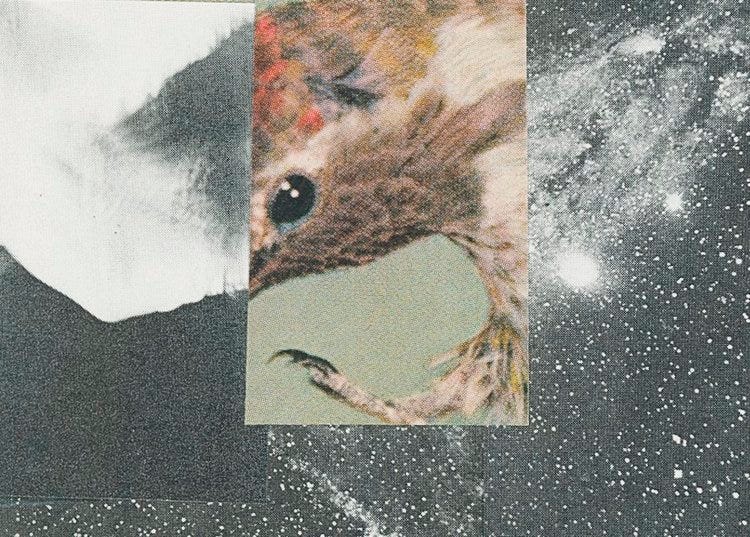
For me, unlikely, impossible connections are the point. When I can align an image of a bird head with an image of a nebula as though they are continuous, I am confronted with a new framing of the world in which they are. To connect what cannot be connected, to work with the tenuous tissue of coincidence is to ask: what don’t we know about what we think we know?
In this way, the archival—and collage—impulse overlaps with the impulse to question reality as it is handed to us—the dominant modes of thinking and seeing. The linear, the chronological. The logical, the measurable. And ask: what about other ways of being, sensing, and knowing?
The 2025 Occult Humanities Conference I attended this month asked that question repeatedly, and the answers were truly fantastic, transcendent.
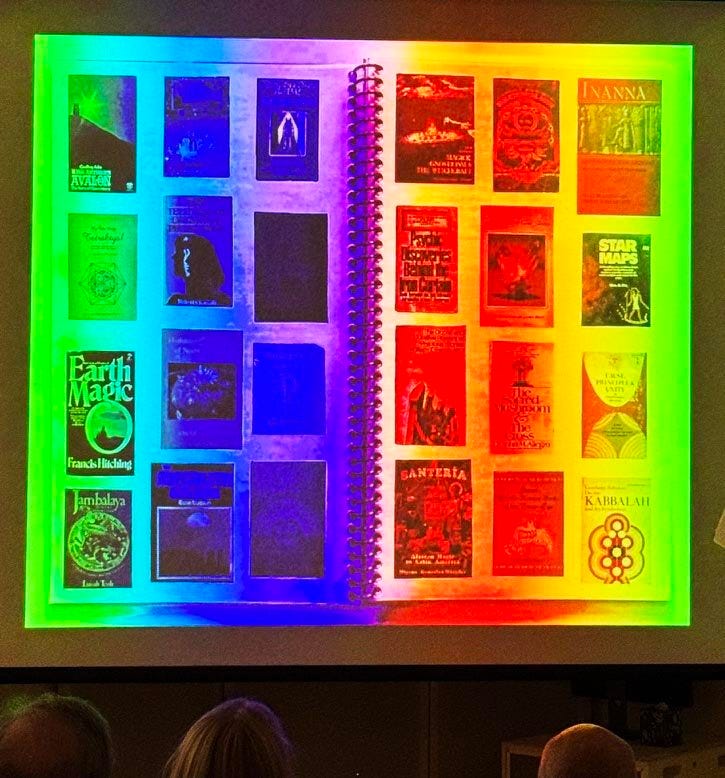
My favorite talk was by an archivist, M.C. Kinniburgh, who is also a poet, publisher, and rare book dealer. (This was a conference that luxuriated in the multi-hyphenate.) Kinniburgh is responsible for saving the occult library of the poet Diane di Prima for posterity: organizing and cataloging the books and finding a home for them intact and together at the University of North Carolina in Chapel Hill.
Looking at the list of books in di Prima’s catalog, which you can access online here, is an act of connecting what cannot be connected. You could work through a whole collection of di Prima’s poems and not get a whiff of the occult. Stocking up on beans and establishing safe houses, yes—di Prima’s poems are full of practical tips on how to survive conservative, authoritarian political climates. But as Kinniburgh explained in the talk, for di Prima it was occult thinking that activated political thinking. Occult reading and political survival went hand in hand for the poet.
Another favorite talk was also by a poet, this time CAConrad, who shared a long list of mentors and peers of theirs who use divination to generate and facilitate writing poetry. You may be thinking, yes, poetry and divination, of course. I read a lot of writing that evokes divination-like themes and images, but I’ve never heard writers talk about process like this and openly discuss techniques. You would have been laughed out of my MFA program and any of the writing conferences I’ve attended for doing so. I’m glad I found my way to this conference to hear an approach that aligns with my own.
The name in Conrad’s talk that leapt out for me was Alice Notley, who passed earlier this year. I know her work but not well; I was drawn to it a few years ago when I learned she made collages in addition to poems. And because I’d seen recent, gorgeous work by the artist Cindy Rehm that was inspired by Notley. This is the sort of tenuous tissue of coincidences—or synchronicities—that spurs me to pay attention. Then Conrad talked about the trance practice Notley used to write her book Mysteries of Small Houses. My jaw dropped. I’ve been folding trance work into my studio and writing practice for the last three years. And now I know I need to read that book.
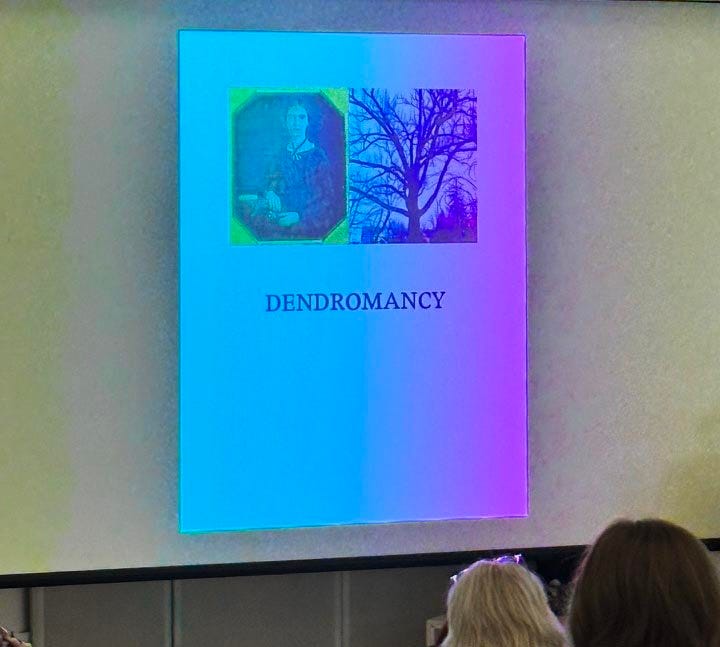
Conrad ended their talk by sharing a writing technique they’ve been using lately, what they call dendromancy. The projected slide on the screen behind them showed two pictures: one of Emily Dickinson, the other of a mature deciduous tree. To connect what cannot be connected. Conrad explained that the tree is next to Dickinson’s house in Massachusetts. It had grown alongside Dickinson, ascending and deepening and spreading while she lived in the house for all her life. It is the house where she was born, where she wrote her poetry, where she died, the tree witnessing all of it. All that exchange of air over the years, all that invisible entanglement.
The technique: Conrad goes to the house carrying crystals—with their constant pulse and information-storing chambers—and buries them in the soil at the base of the tree. Leaves them 72 hours. Then digs them up. The crystals then become poetic guides for Conrad and for their teaching. They use the crystals when leading workshops, encouraging the students to sit with them, ask questions, listen. And always the result is the same: the students write the best, most unexpected and vibrant poetry of their lives.
N E W S
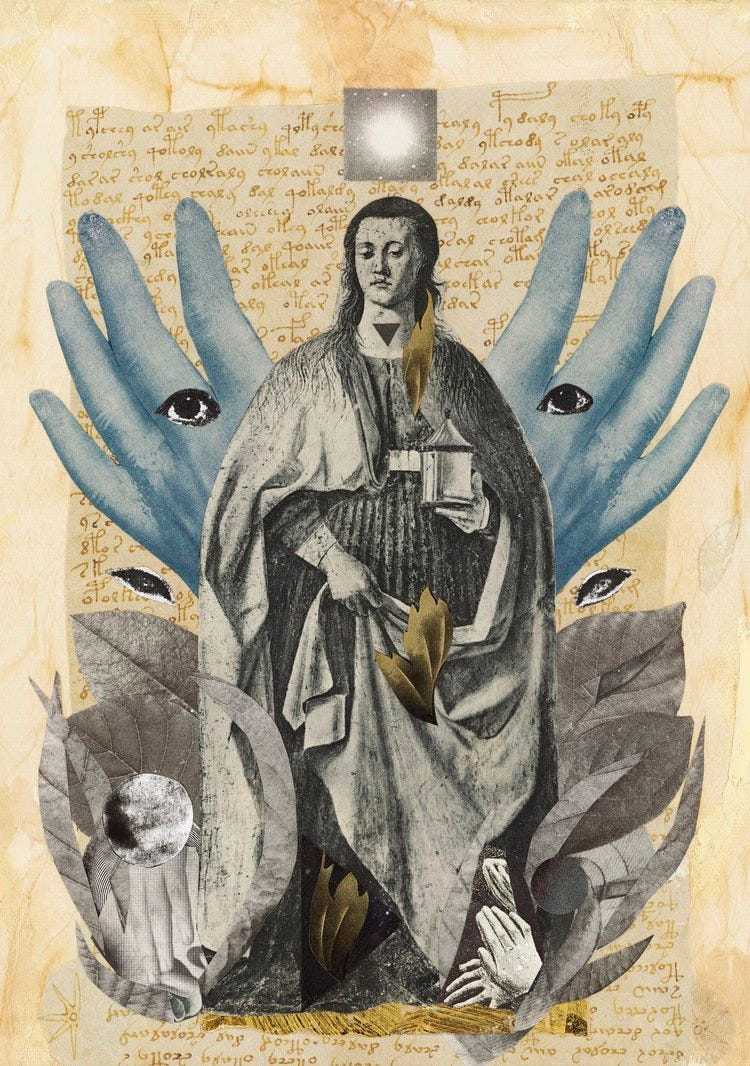
- Interested in owning a print of my collage work? I’ve decided to do a limited fine art print run of Goddess of the Deep Self for 2025. It’s the image at the bottom of this newsletter. Printed with archival ink on archival Hahnemuhle German Etching Fine Art Paper, it absolutely hums. One size only, 8.5 x 11 inches, with a limited print run of 30, signed and numbered on the back.
The cost per print is $65, and I’m opening the sale to you lovely newsletter readers first before I share more widely. I am covering shipping fees for the US; I’m not shipping internationally. Send me a message if you are interested.
- E1507 Gallery is holding an open house on Thursday, November 13, from 2 to 6pm. It’s a chance to see my show A Field Guide to Entanglement and chat with me — I’ll be at the gallery for the first few hours. It has been a month and a bit since the opening, and I’m looking forward to being back in the space to see how the pieces have settled into their surroundings. A webpage with install shots is available here, and you can see images of the work in the show unframed, up close, with dimensions and other details here. Up through January 15.
- Two works from my Victorian Feelings series will be in the show Parallel Cosmologies at Ursa Gallery in Bridgeport, CT, opening November 7. Curator and collage artist Helen Kauder is bringing together the work of more than 60 collage artists working in Connecticut for this show—that’s the largest group of artists I’ve ever shown with, and I’m excited to see how the pieces talk to each other. Up through December 31.
Here’s to connecting what cannot be connected,
Lesley
Wonderful text with so many interesting things to return to. Thank you.