mapping conjuncts
collage mind newsletter / vol. 54 / June 2026

Dear Friends:
We’ve just passed the summer solstice. Here, the sun sat unopposed in the sky, the air was sweetened with honeysuckle perfume, and my thoughts were shining on a word: conjunct.
There was a planetary alignment last week on my birthday that pushed the word into my radar range. My attention magnetized. I looked the word up. It is beautifully multiple: in grammar conjunct refers to parts of speech that connect independent things. In music, melodic progressions that move through small adjacent steps. In astronomy and astrology, planets or other celestial bodies that, to the human eye, appear right next to each other in the sky.
We can derive meaning from these conjunct relationships. Or not. But I like meaning. A friend recently observed that it seems like I never have a casual encounter with the world. I don’t think I do. I love tracing patterns and relationships. I love finding ways of deepening that reflection: conjunct feels like an invitation to that deepening.
I like that it is both noun and adjective. That it is shorter and catchier than conjunction. Almost onomatopoeic. That the astronomy/astrology resonance suggests conjunct is seen but has much more complex, physical dimensionality. Stars appear to be separate when they are side by side, but in fact are exchanging heat and light. Planets are orbiting and spinning though they seem still.
Do you take time to notice what’s in conjunct for you?
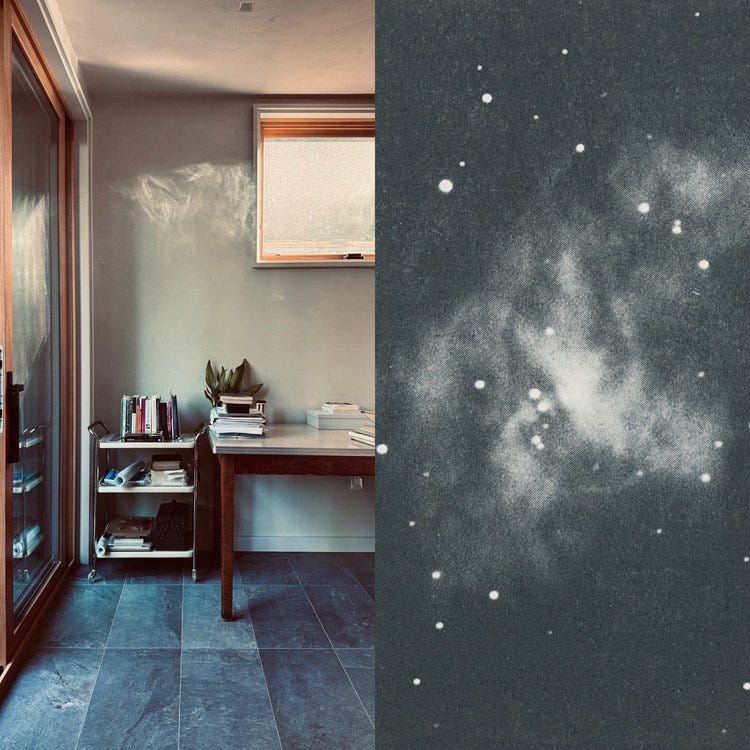
There are lifelong conjuncts, and fresh, random ones. Noticing them is a bit like developing a personal cosmology. What joy.
What’s become clear to me after the last few weeks is that I have a conjunct of houses.
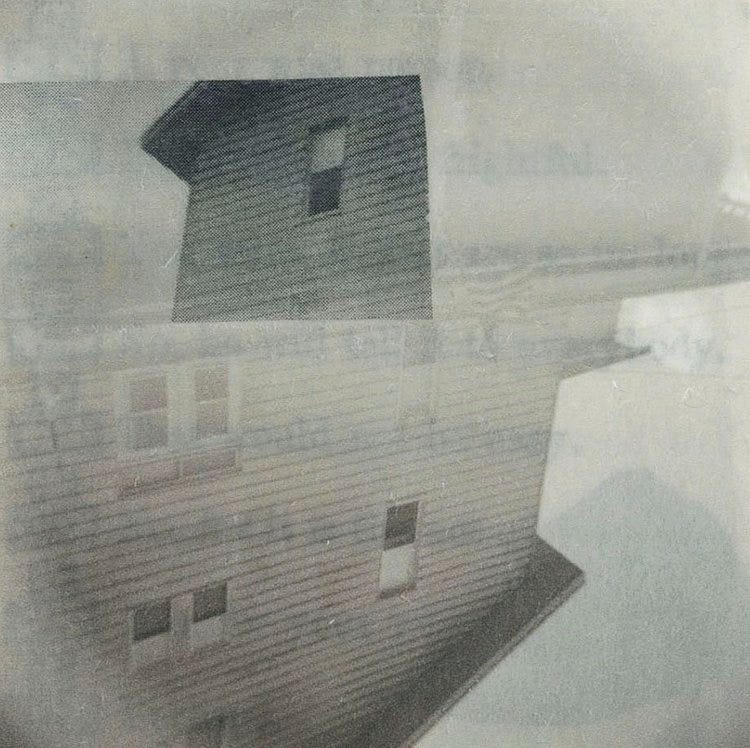
No, I haven’t suddenly inherited a bunch of properties. That is definitely not in my horoscope. It’s simpler than that: I think in and through houses. What they mean as a symbol, how they are experienced as a space. It’s a theme that sneaked up on me, although it has been there all along in all my creative work, exchanging heat and light.
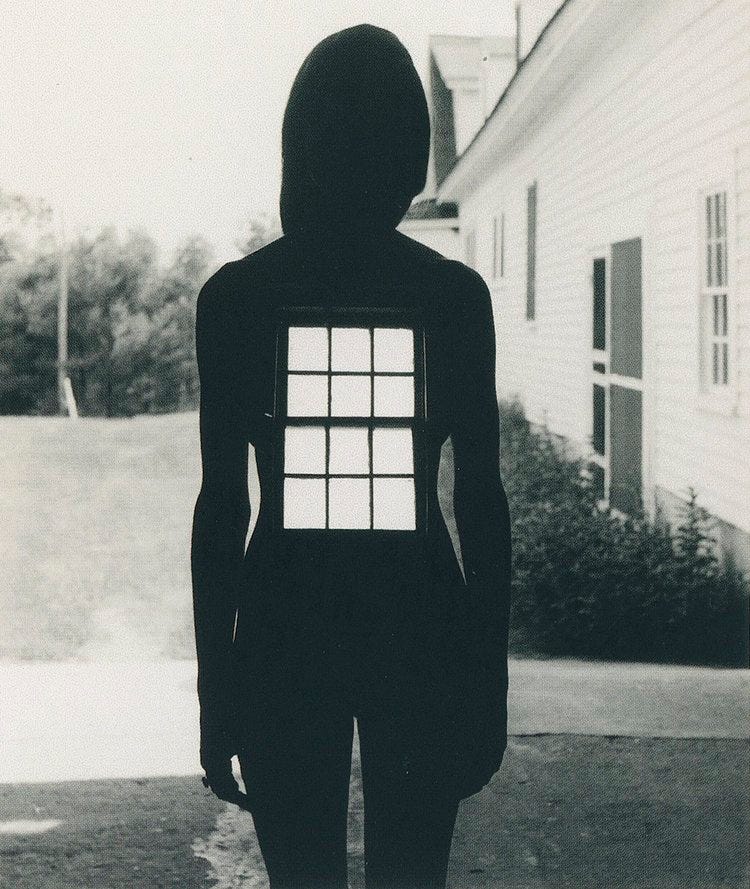
The collage artist Penny Slinger has this statement on her website: “I make artworks to bring the inside out and the outside in.” Houses help me do just that.
How and where and why a motif emerges is one of the great pleasures of interpretation. Because there is never a right answer. Why houses? I could start with the fact that I grew up in a house among identical houses, a neighborhood of row homes. Maybe I became curious about what’s inside because the outsides were the same. Brick and white trim and mimetic dimensions gave way, once through the front door, to infinite variety. The house to our left was ruled by two standard poodles. Up the road, my friend’s house had plastic covers on the couch and a fridge full of Tab. Across the shared playground my other friend’s house had a blue velvet chair coated in the fur of their ginger cat, framed Michael Jackson LPs on the walls, a first floor that smelled of Virginia Slims, and a second floor that smelled of Downey fabric softener. I babysat at a house down the block with no TV or radio or record player, eerily quiet. Another that had a kitchen with many weeks’ worth of dirty plates and pots stacked on the counters and in the sink, a dining room that doubled as a newspaper storage facility.
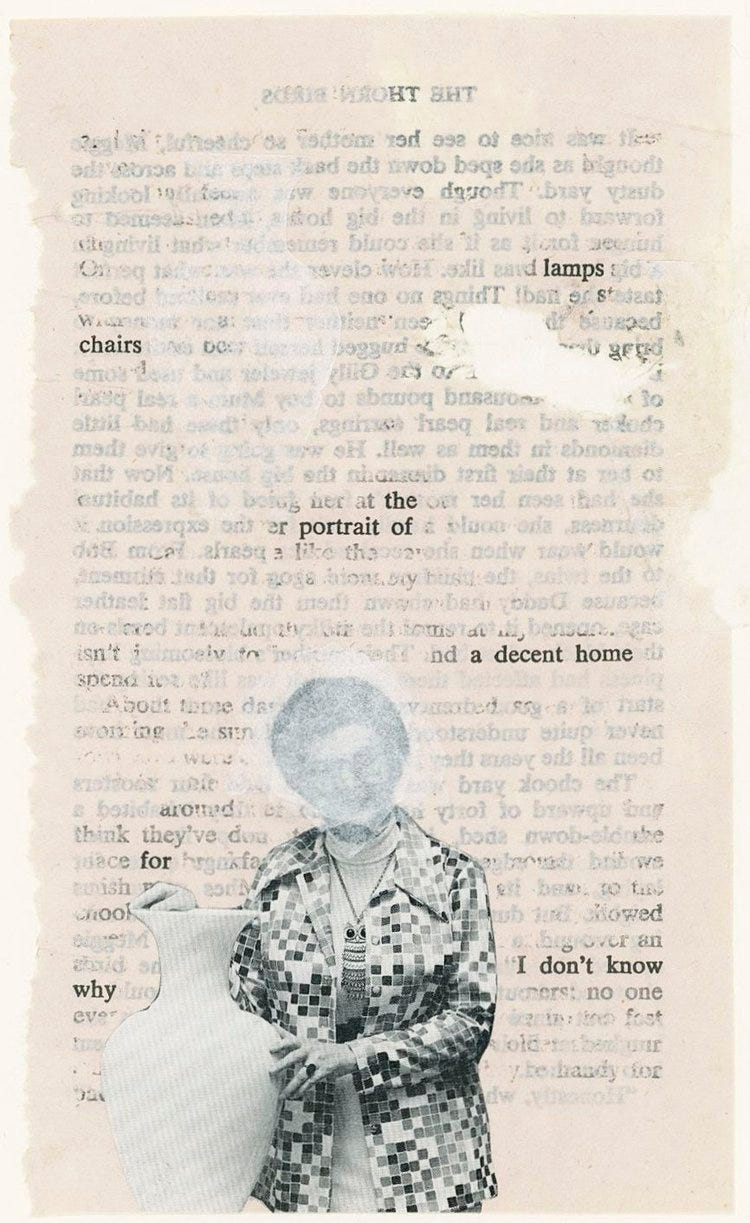
Houses play crucial roles in almost all my writing projects.
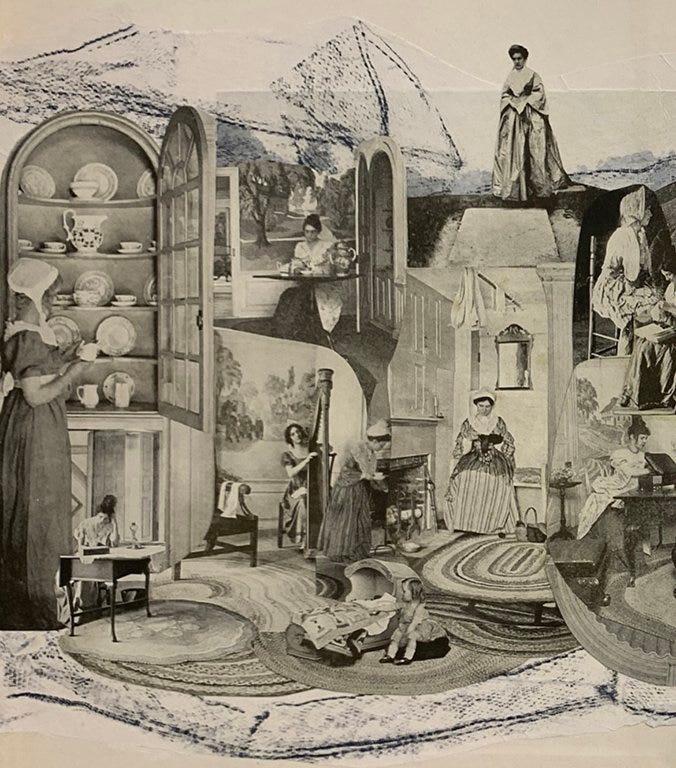
I’ve written about sinking houses, unexpected houseguests, secret passageways, unhappy homecomings. A few years ago I published a piece that talks about the word stanza in poetry, which also means room in Italian. I love thinking about a poem as a series of rooms. I love rearranging rooms. It struck me this pleasure is still with me now, that it is in a way what I am practicing in my visual compositions. Moving pieces around, trying to find that moment when the room makes sense, when it suddenly feels like a sanctuary, a place that can hold truth.
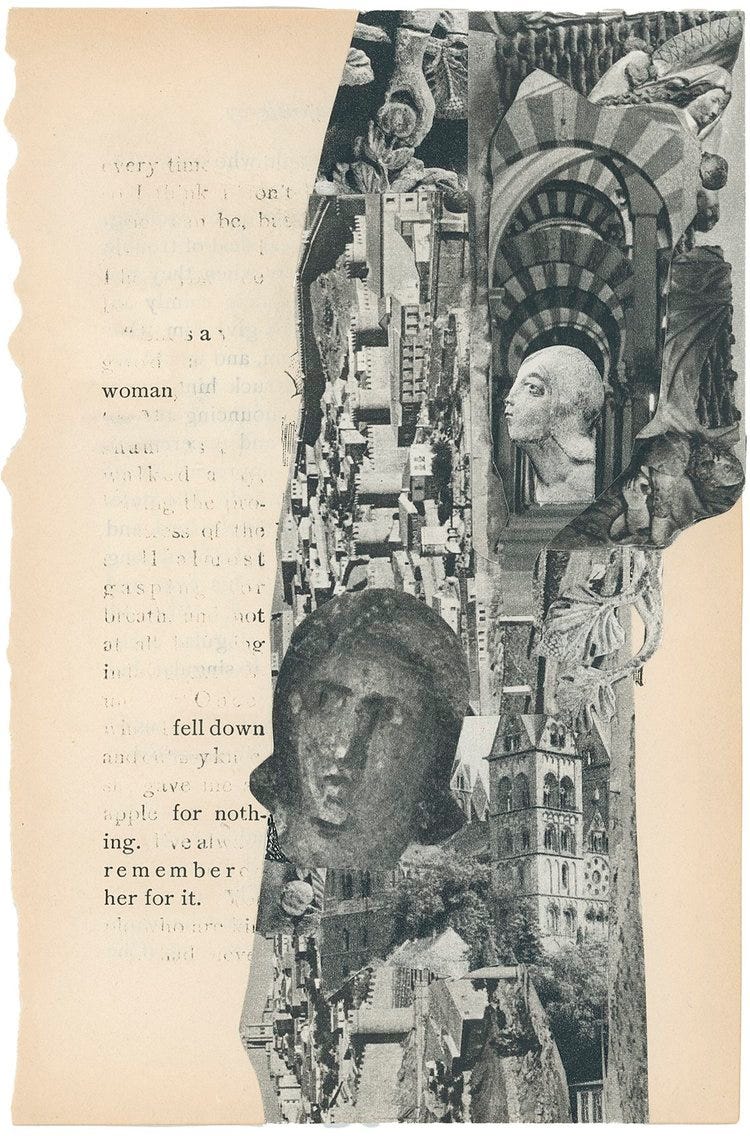
I did all my creative work from home until five years ago when I started to rent a separate studio space. That too is another house. I’m starting to feel like I might need to move out of it into a bigger space, that my ideas have outgrown it, which is a new feeling for me.
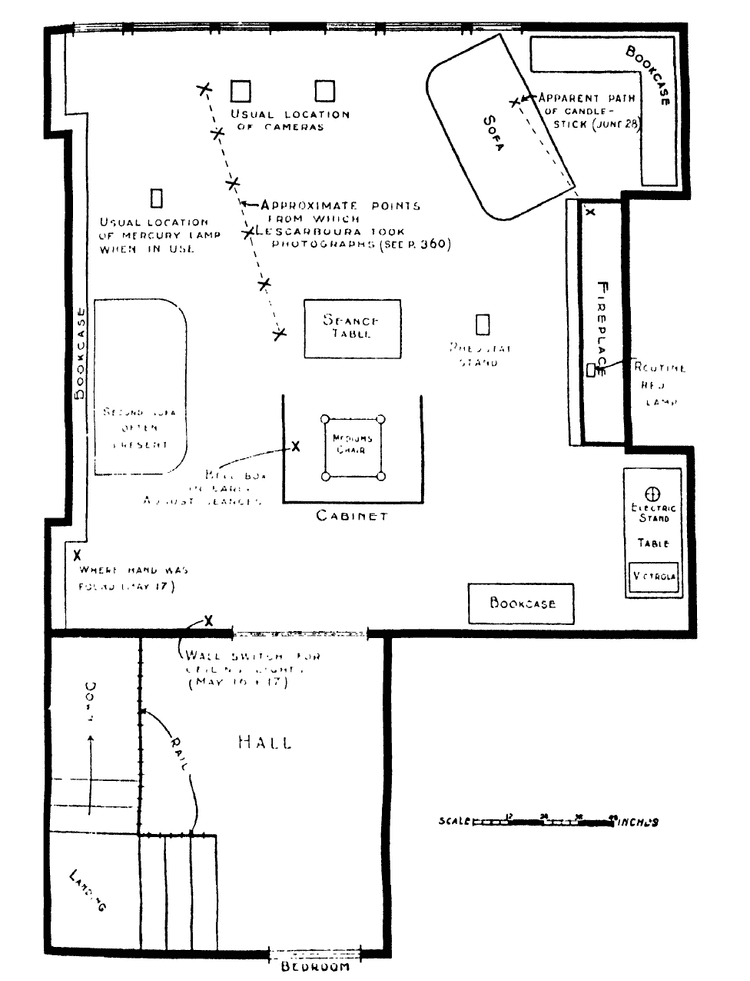
Last month I travelled to Boston to see the former home of Margery Crandon, a séance medium I’ve been researching and writing about for a few years. I’d seen photos online, found floor plans in books, but felt strongly I needed to see the space where she held séances, even if only from the outside. The feelings were right. She lived in Beacon Hill in the 1920s, a neighborhood of shocking wealth then and now, displayed in its look-what-I-possess style of architecture. Sprawling mansions in the middle of a city. Huge front gardens.
But all the material I’ve read on Crandon failed to note what I saw when I stood in front of her house: that it is downhill from the big properties the neighborhood is known for, slotted into a cramped street. There was no grandeur, past or present. There is barely room for one person on the sidewalk. I had to avert my gaze so I wasn’t staring through the front windows, inside to the living room, where the TV was blaring Fox news. Crandon may have lived in a prestigious neighborhood, but she lived on the wrong side of the tracks.
And then there are haunted houses. I mean, you can’t grow up watching Poltergeist and not be curious about the sentience of land and the structures built on it. While in the Boston area I took a mind-blowing tour of the House of the Seven Gables in Salem, which was the basis for the Nathaniel Hawthorne novel of the same name. It felt like a parable of America: a house built on land procured through a defaming threat, cursed with intergenerational trauma.
That’s the book; the house is a parable of America too. The owners built additions on the structure following the publication of Hawthorne’s book—to align reality with fiction for marketing purposes, so they could entice visitors inside and charge for tours.
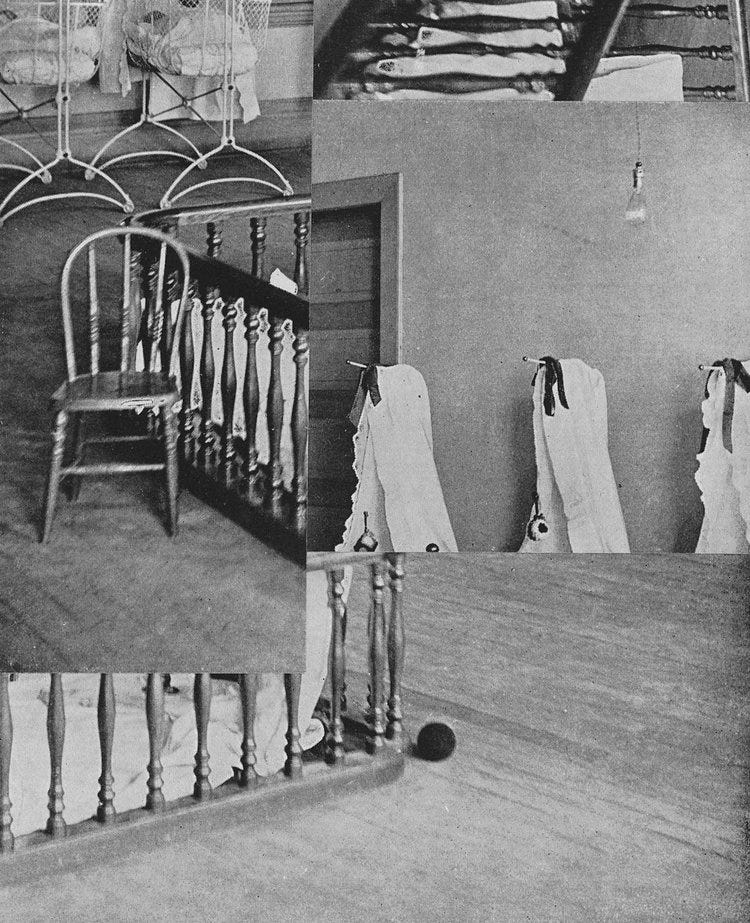
Maybe a collage is a haunted stanza. Both poem and room, fused with multiple timelines. Spaces are not neutral, spaces carry charge. The book is a house. The canvas, a house.
I haven’t even mentioned dreams. I’ve lost track of how many nights I’ve had 2 a.m. visions of an extra room I didn’t know existed, sometimes a whole floor. Never nefarious in that Backrooms way. I can feel the elation from those dreams, that astonishment at the expansion that was all around me, that somehow I hadn’t before noticed.
As June ends, I’m wishing you a kindred noticing of your cosmologies and conjuncts, with all the best expansive joy.
-Lesley
N O T E S + N E W S
-If you are a horror film person, or a film person in general, go see Backrooms. I have studied and written about horror as a genre and am almost obsessively on the lookout for its reliance on misogyny and other punch-down short-cuts to tell a story: Backrooms is a rare feat of storytelling and filmmaking that doesn’t lean on any of them. Honestly, no notes. It’s an exceptionally smart film about the dangers of not facing your shadows. Directed by a 20-year-old, based on the YouTube videos he made as a teenager. Brav-the-fuck-o Gen Z.
-My piece Charter of the Stone Within was selected for Cutting Edge, a juried show of New England collage artists at Bromfield Gallery in Boston. You can view the online exhibition here through August 1.
-My triptych Victorian Feelings will be on view at AUTOMAT in Philadelphia in negotiation, a group show curated by Jo Nakayama-Painter, opening July 5 and running through August 1. I will be at the opening event on July 9: Philly folks, would love to see you there!
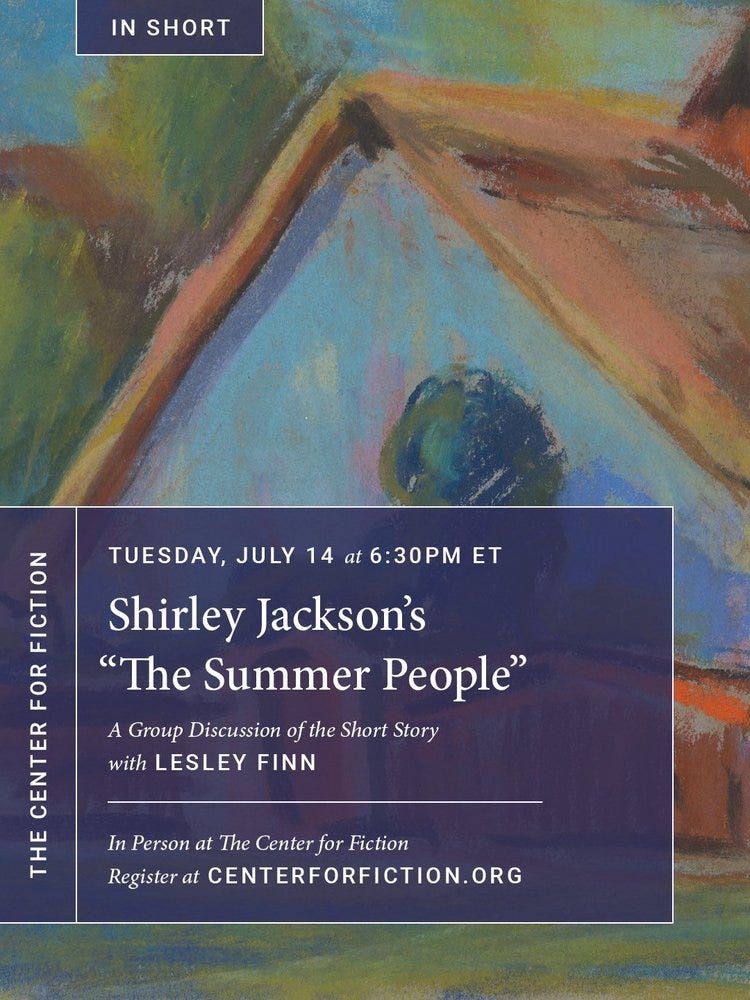
I’ll be in NYC on July 14 to lead a one-evening reading group on Shirley Jackson’s short story, “The Summer People.” Surprise: it’s about a house. The story is a craft-dense seven pages, and I can’t wait to unpack it with fellow readers. There’s space for a few more folks to join if you or anyone you know is interested. Registration comes with a free drink from the café-bar and a PDF of the story.