
make the invisible seen
collage mind newsletter / vol. 51 / March 2026

Dear Friends:
What is your relationship with the month of March? Here in the northern hemisphere, March marks the start of spring, and globally it marks the month of International Women’s Day, and, in the US, Women’s History Month. I’ve found, for the last few years especially, that while I am rejoicing the extra daylight and the greening around me, I also reflect even more on issues of gender equity and justice than I usually do. International Women’s Day and Women’s History Month draw my eagle-eyed attention to how attached society is to binary gender roles, how slow institutions are to change. This year, with the ongoing revelations about the Epstein files, reflection has turned into rage. And it is pushing through with vigor, akin to new growth from soft earth. I can’t decide what is growing yet: a flower, a strangling weed, both.
On International Women’s Day last year, I happened to watch the 2023 Wim Wenders documentary Anselm about Anselm Kiefer. Earlier in the day I had been reading some essays about the pay gap and maternal mortality and other joys of living as a woman. I had read more than a few stats about how underrepresented women are in so many sectors, including the art world. And then, hours later, I sat through a documentary about Kiefer, one of the world’s richest artists, with that critical lens scrubbed crystal clear.
Anselm is a lone hero’s journey kind of film. The great man and his art. Aside from a few shots that include his assistants, he is presented as a solitary force of genius, wandering his airplane-hangar-sized studios, often on a bicycle.
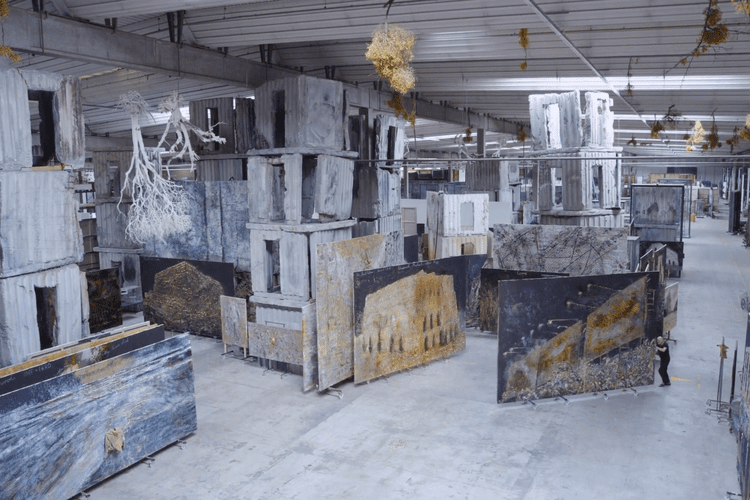
I can’t deny that Anselm is full of beauty. But while my eyes enjoyed the aesthetic splendor, my mind was doing gender flips. Watching, I wondered: Do any women artists earn even close to what Kiefer does? If they did or do, would they also own so many vast real estate properties devoted to their art? Would they be shamed for that or, like Kiefer, celebrated? Would a film be made about them by another famous artist? And would that film be like this one—where their romantic relationships and reproductive choices are left entirely out, the focus given purely to artistic process and production?
The first question was answerable. I let that rabbit hole be my IWD gift to myself. Kiefer, with a net worth at over $100 million, is one of the richest living visual artists in Germany, but does not rank in top lists worldwide. All those positions, though, are taken by male artists — Jeff Koons, Damien Hirst, etc. When I enter the same search terms “highest net worth of a living visual artist” and add “female,” the language changes. The Google results tell me net worth is hard to measure, after, moments before, they numerically listed the net worth of men. The results instead offer information about the highest selling artwork by a woman and lists of “the most expensive female artists.” As if female artists are a cost to be budgeted, not a value worth measuring.
The numbers hit a ceiling at 1/16 of Kiefer’s.
On International Women’s Day this year, I was traveling with my daughter in Rome. I knew the holiday was coming up, but had forgotten on the day of — until, because of the holiday, we got free admission to a historical site we were visiting, the Baths of Caracalla. (I saved 10 euro! Look out Anselm Kiefer, here we come.)
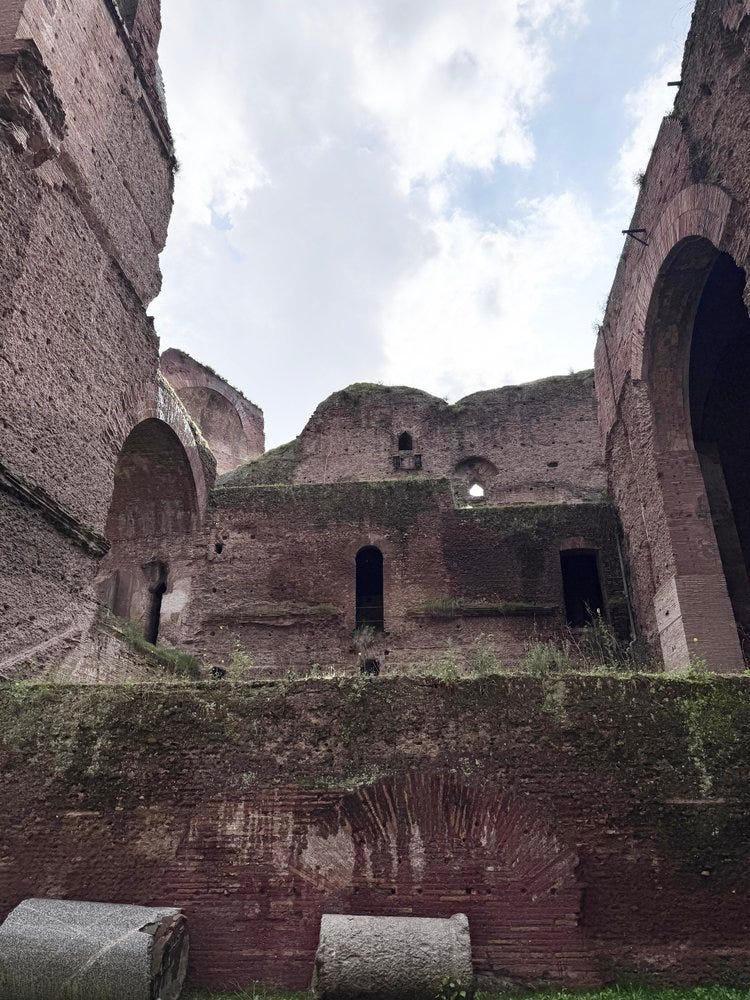
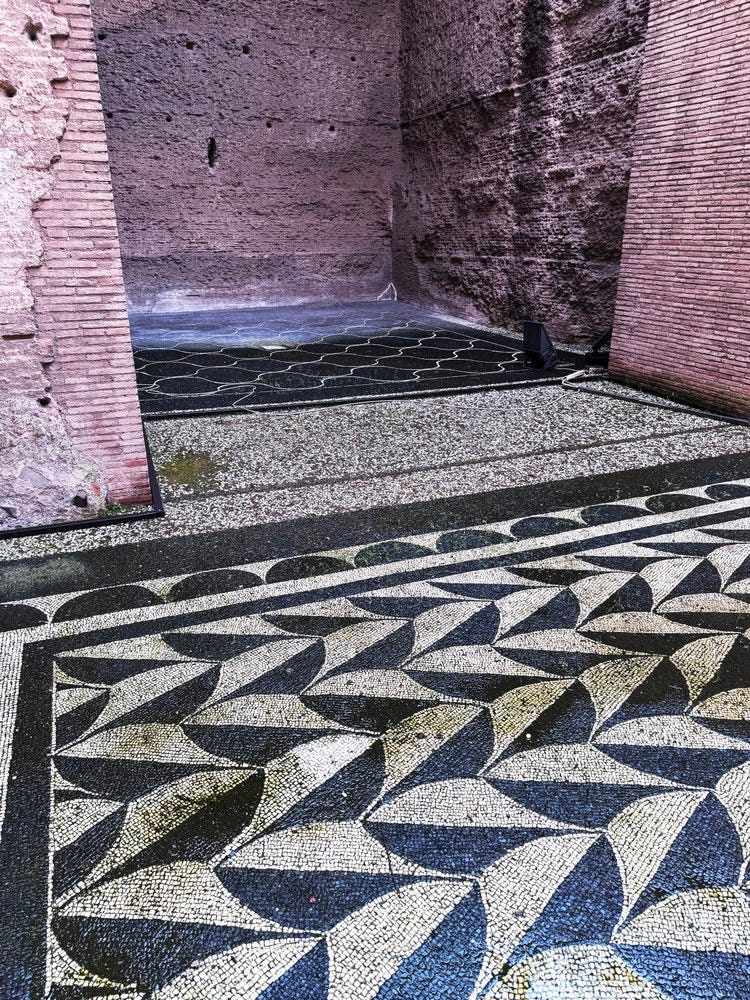
These baths were once the second largest public baths in the city, and date from 200AD. A long time ago, right? And yet, when we rounded a corner within the ruins, both of us gasped with recognition at the original mosaic tile floors. They looked like they’d been designed yesterday — not nearly 2,000 years ago.
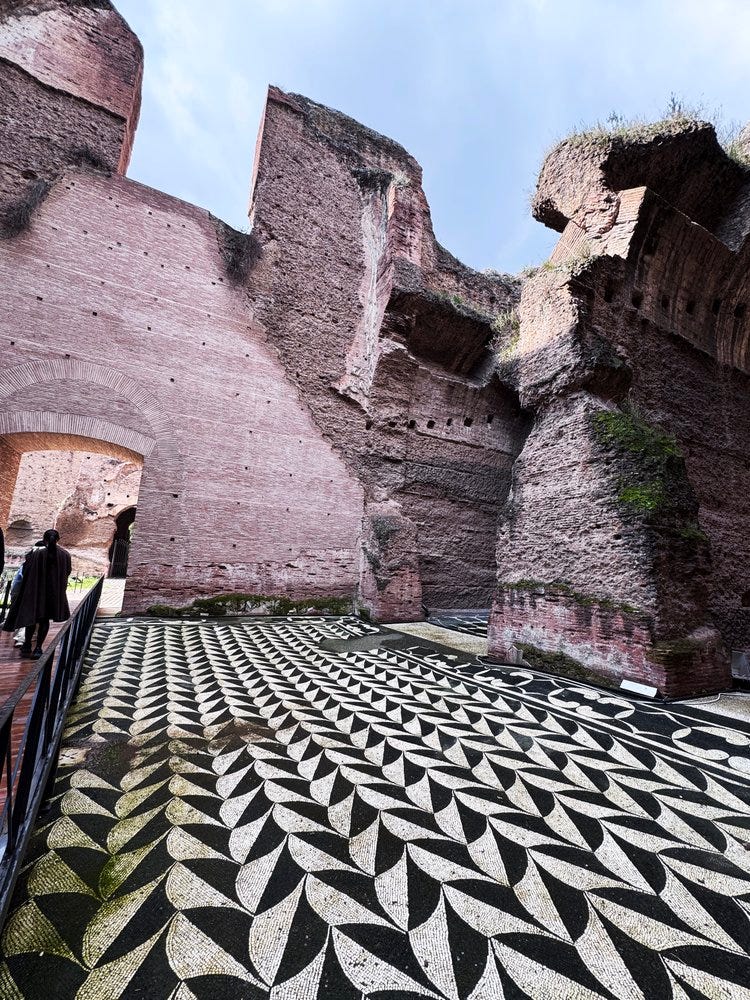
For the rest of the trip, my daughter and I couldn’t shake that experience. It felt like an illustration of something the two of us talk about a lot: that the past and present are far more complex, more interwoven than that simple binary of then and now. Walking around that city with ancient walls and sculpture intermixing with modern buildings and everyday bustle, the coexistence is undeniable.
If only structural patriarchy were made of brick and we could see it so easily.
The next day we were at the Vatican Museum — which, admittedly, is a solid example of structural systems of oppression being made visible. My daughter was astonished at the seemingly endless number of annunciation paintings, how repetitive the scene was. I noted how I interpret those paintings as propaganda conditioning women to be interruptible. We cracked some excellent jokes at the expense of Catholicism. Sorry not sorry.
The most compelling art we saw was in the Hall of Constantine, an ornate room with walls and ceilings painted with the church’s greatest hits— suppressing paganism through terror and violence, etc. The hall was completed in the 1500s. Of the dozens of figures and scenes painted on the walls, my focus was fixed a single woman, perched above the doorway to the next room.
She is dressed in a sort of Renaissance BDSM outfit, holding a dove. To her left a cherub points to both her and a blank scroll, seemingly urging the pope seated next to him to make some decision about the woman, write her fate. Art history tells me she has no name (what a surprise). She is an allegory for purity and innocence.
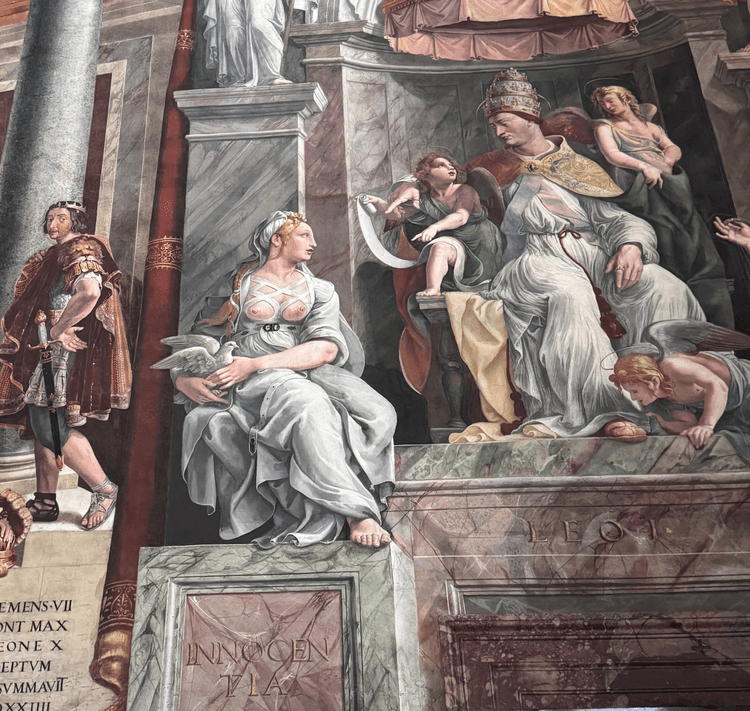
I saw a woman who looks bored. Resigned. Not this shit again. She looks like she is protecting her dove from the cherub and the pope. She looks like she is ready to snatch the scroll and rip it to shreds. She looks like she is ready to slide off the wall, and stride away, writing her own fate.
This woman, a fragment of a massive painting, reminds me why dealing in fragments is so important. By focusing on them and scrutinizing their context, then giving them a new one, we bring stories and lives and materials marginalized in the archives and history books to the center. We shatter the patriarchal lens and see the material anew. Collage, with its material deconstruction, can help us see the invisible structures that protect and perpetuate limiting ideology. And collage, through material reimagination, can illuminate a path forward—even if sometimes it’s only to spotlight the path that should not be walked again.
N O T E S + N E W S
It feels like the right month to share the work of three women artists I admire and who have been so important to my own development as an artist.
-The sculptor Michelle Lopez has a solo show, Shadow of a Doubt, at Tufts University’s Aidekman Arts Center in Boston, open until April 19. Lopez’s work is all about making invisible structures visible. Her mesmerizing video sculpture ‘Pandemonium’ was at the Whitney Biennial this month.
-Jen Bervin, a current Radcliffe fellow, gave a luminous talk about her archive work last month, which is now available as a recording here. Bervin’s work uses research, erasure, and installation to make the subtle seen. Her large-scale quilts of the dashes in Emily Dickinson’s manuscripts are extraordinary.
-The writer Joanna Pocock has recently published her second book, Greyhound, which ruminates on the decline of public spaces, late-stage capitalism, and other important, searing themes. I loved her first book, Surrender, too. She writes about place like no other writer I know, and interweaves stunning on-site photography throughout her projects. Both her books were originally published by Fitzcarraldo Editions, a dream press that if you don’t know about, please do check out.
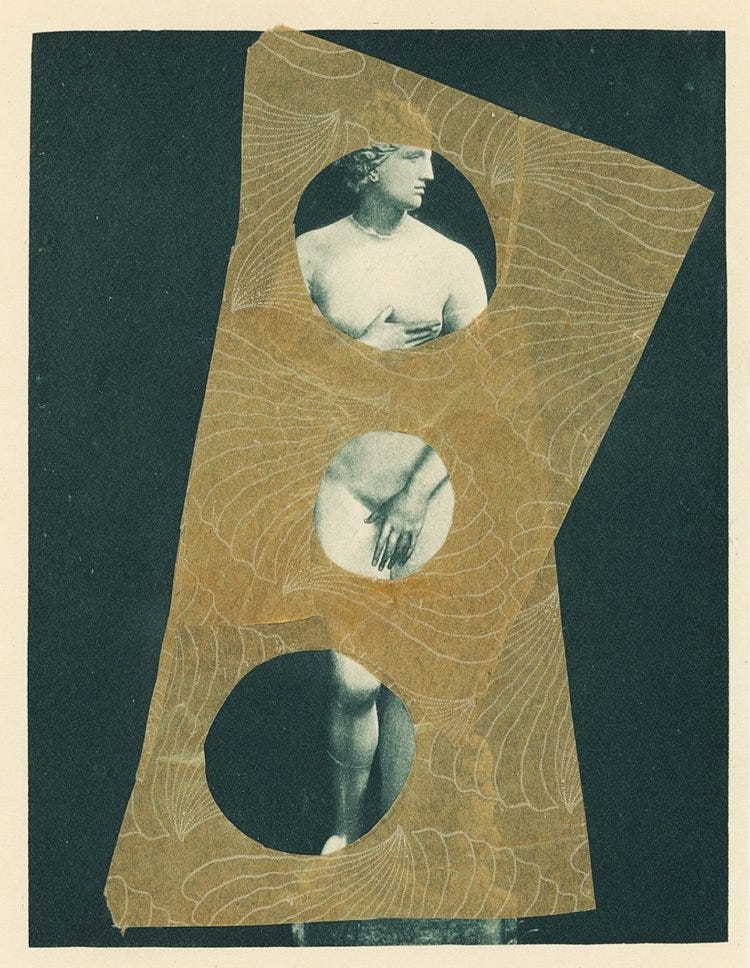
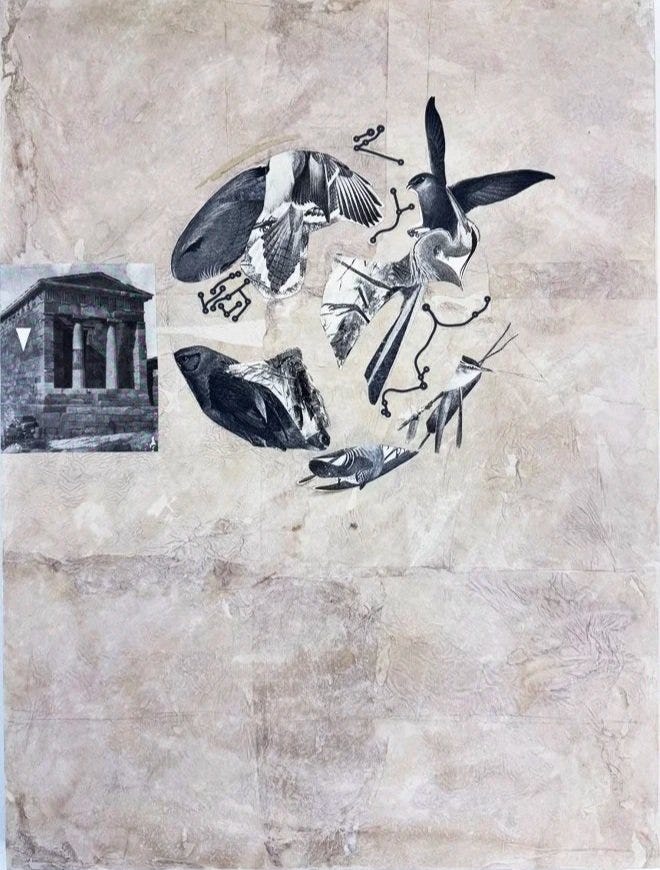
As for me, I’m busy working on my nonfiction book project and preparing for Building Blocks, a small group show I’ll be in this May. In both cases, the work has been a slow gathering of fragments, full of sudden insights and unexpected alignments. A taste of where I am in the studio:
Yours,
Lesley
wonderful read. thank you